
Is the press release *really* dead?

Wed, Feb 2, 2011

PR, Uncategorized

According to Forbes reporter and blogger, Aaron Perlut, the answer to that seemingly ever-present question is “yes.” He even says so in the very first line of his recent post on Forbes.com: “News releases, in most cases, are a worthless bother.”

Perlut goes on: “The traditional news release is a dreadful animal–read by few–and should be put out of its misery.”

Pretty strong words, right? A shot across the bow of the entire PR industry.

But, as you continue to read Aaron’s post, he makes a couple valid points, including:

* “I receive at least 10 relatively illegible news releases daily (and many reporters tell me they get up to 300 each day). And rarely, if ever, can I get past the subject line in my e-mail inbox.” — I don’t doubt this for a minute.

* “In most cases, companies are still writing for their CEOs, not their audience. If they really consider it, they should write for them, not at them.” — Quote from Jason Kintzler in the story, and a really good one (bringing up a topic we don’t talk about all that often).

Both great points and both correct in their own respects.

Except, here’s the thing. I’m not sure it means the press release is *really* dead.

Hear me out.

I respect Perlut. I’ve never met the guy. I don’t read his column/posts that often. But he’s a writer at Forbes. You don’t get that of  job by accident. But keep in mind, he’s just one journalist. And he offered up no research or empircal evidence (other than his inbox numbers) to back up his claim. It’s merely his opinion. And he’s certainly entitled to it.

And, let’s be honest, this isn’t the first time we’ve heard a journalist complain about news releases. Heck, that simple concept spawned a cottage industry with the launch of HARO (also noted in Perlut’s post).

This doesn’t mean PR folks are off the hook, either. Perlut’s claim about poorly written news releases rings true. We’ve all seen them. Heck, read the Bad Pitch Blog for a few weeks–you’ll see them. We just have to be more concise. Smarter. More compelling in our writing. And, make every effort to cut through the insidious, and pervasive, corporate jargon.

Not too tough, right?

The other factor that leads me to believe the press release is nowhere near dead just yet: Other journalists have told me. Yes, actual journalists who work at real news outlets.

Here’s just a few of the DMs I’ve received from journalists the last few days after I asked them “is the press release dead?”:

* Gregg Litman, senior producer-news/sports, WCCO-TV. “No. Distribution methods may change, but we still need information/text to save, forward in office, give to reporters, & use as a reference.”

* Julio Ojeda-Zapata, technology reporter/blogger, St. Paul Pioneer Press. “It’s still part of toolkit but has to be executed competently/creatively.”

* Dave Schwartz, sports reporter, KARE-11: “For sports, news releases are alive and well. We rely on them heavily for team news and events. Also PR firms use them to let us know about stories.”

And, finally, this tweet from WCCO-TV’s Jason DeRusha last week:
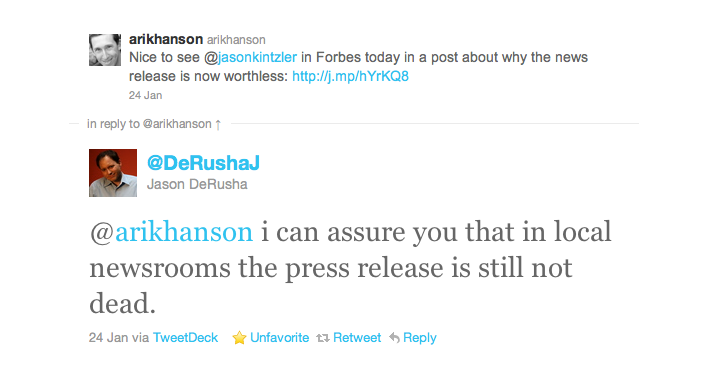
So, given those debates an claims, what do you think? Is the press release *really* dead? Or, have tales of its demise been greatly exagerrated?

Note: Photo from Jason Mollica’s post dated Sept. 13, 2010.

Subscribe to Communications Conversations by Email
Related Posts Plugin for WordPress, Blogger...
, , ,
Post comment as twitter logo facebook logo
Sort: Newest | Oldest

No, the release is not dead. Mediocrity is dead. The days of mass emailing the same old press release out are done. The ante is upped and the pitch has to be perfect. As a publicist based in a small town in western NC, but pitching to folks all over, I can say that the press release is not dead. There are still some reporters and editors out there who will write exactly what I (or any other publicist) give them, so I better send it well written and ready to go.

There are just as many who want something written, but in short sound bites, with links to back up info and with images, multi-media, etc. These journalists still rely on the pitch and then take it from there. But without any background info, they won't. They in fact depend on it and will request it from me if I only send the pitch email and not the back up release.

It's really no different now than it was 10 years ago...if you don't have a good relationship and credibility with the reporter or journalist, your pitch will fall flat. The release is just the background info they need to do their story. I know I'm in a small pond here, but there are lots of these small ponds all over the country that still function in the same way.

Thanks for bringing this side of the conversation to the table. I especially appreciate the journalist perspective you provided throughout.

I think the pertinent question is "What is a news release?"

I almost never write news release with reporters in mind as my audience. I'm writing them in narrative format, as if I were the reporter. Think of it as "corporate journalism." And the audience is the public. Now that methods exist to tell our own stories, and for those stories to reach consumers directly -- without a media middle man -- we need to re-imagine what a "news release" is.

It's a no-brainer that members of the media will tell you the press release is not dead and that is precisely because they, too, are generally neophytes in online media adoption and don't have feelers out getting the news. If not emailed the news, how else can they report it?

Oh, I don't know about that, Ari. A few of the folks I featured up top in this post glean story ideas daily from Twitter and other social networks. I'm not ready to throw the entire mass media industry under the bus on this one just yet ;)

Thanks for tackling this Arik. It needs to be addressed. There are so many reasons the press release is not dead, to list them all would take too long. First off let's agree that although we love journalists, and many of us in marketing like myself used to be one, being one by itself does NOT make you an expert on good PR. Period. (This is like saying patients who receive surgery should immediately go out and perform it on others.) Journalists all whine about poorly written releases and being targeted inappropriately by lazy PR people who don't do their homework. And they should. That's very legit, but it doesn't follow that ALL PR is done that way and no one in PR does it right. And it sure doesn't follow that therefore, "press releases are dead." On the contrary.

To listen to the press release commentary on social media is to hear three conflicting views: releases are dead VS. releases are social and 2.0 reinvented VS. releases are now SEO fodder for Google juice intended for direct-to-consumer communication that cuts out mainstream media. Well which is it? Hardly anyone takes a stand on this. The few that do are pushing their own commercial agendas.

Greg and Julio's answers are instructive. Press releases should still be part of the toolkit and have a legit role to play, but need to be done professionally. I would add that some *applications* of press releases may be passe as to form, but at the same time there are more uses for them than ever before. Let's not forget, for example, that in survey after survey web site visitors report that the news/press release section is the very FIRST place they go on a company's site. So, umm, you want that to be an empty room?

Well done press releases are and will be a staple item for content marketing programs for years to come. Still not convinced? OK think of it this way. A press release is nothing more than ~400 to 1,000 words written in an organized fashion to try to communicate a set of ideas and give their significance in some context that's relevant to the reader. So who now wants to propose that all such 400-1,000 word documents are "dead"? This notion is part of a larger trend in which marketing best practices get totally confused. It's an epidemic. Instead of trying to parse best vs. bad practices, people are concluding that certain tactics, like releases, are categorically "dead" simply because there are instances of poor execution. The truth is when these tactics are executed correctly, they work.

I would say the press release is not dead but its *relative* importance in marketing is greatly diminished. I'm seeing companies reduce their spend on PR and shift to creating personal brands for their thought leaders through many channels like social media, speaking, etc. The opportunities for earned media in the press channel shrink every day.

Hmm...I think that's probably a somewhat accurate claim. I don't know if its "importance" has diminished, but there certainly are more options at your disposal now. I think that's probably what you're getting at. But, that press release still has value in reaching out to larger mainstream outlets (i.e., WSJ, TV, etc.). I mean, you can go ahead and tell your own story on your blog, but the reach you can still obtain with MSM outlets is still too large to ignore in many cases.

With respect, that's not what I'm getting at. The importance of the press release has diminished because the opportunity for placements has shrunk. I'm not advocating abandoning them altogether, but as the opportunity for MSM placement has diminished, PR needs to build a more well-rounded strategy. One of the missed opportunities so far is in building the personal brands of internal thought leaders (more relevant in B2B than B2C).

@pr'srded -- thyr anakrnizms..buhlee-dat!

really?

YAY to to you Arik for "pushing back," and to Heather (@prtini) for her alternatives in that recent post. As they say, there's more than one way to crack an egg ;-).

Press releases are not dead. Not too long ago I placed one on PRNewswire. I received several calls regarding the release as it spread across the web. It wasn't super news, so I didn't expect much. I've submitted a number of Press Releases in my local paper regarding major business change and/or events sponsored by my business and always get a good response. Newspapers & TV are not dead. Social Media is not dead but YouTube is working at killing its share off with irrelevant videos . IMHO the only PR that is dead is the unsolicited CD...AOL killed that off. All the releases must be well written, be somewhat newsworthy and not boring.

Arik,

Appreciate your post and your thoughts. Just to be clear, I said there is a time and a place for the news release, such as earnings and major events. But for the most part, news releases have become a highly abused tool implemented by people who don't understand how to use them.

Regardless, thanks again for reading and for your perspective.

Aaron

Thanks for the comment, Aaron. And thanks to being open to discussion. Question for you since you're on the receiving end of so many releases: You say they've become a highly abused tool--what percentage of those you receive would you say fall into this bucket?

Newspapers are dead, radio is dead, magazines are dead, press releases are dead. Everything is dead.

Certain people have a vested interest in certain sides of this argument. It's like research, you can find a valid point for whatever side you happen to be on.

The gist of the argument, and what people have commented on, is that poor PR and simply going through the motions is no longer a viable option for communication folks.

If done properly, EVERYTHING has it's place.

Bill Sledzik, a comms professor at Kent State wrote that he first heard about the death of the press release in 1979. Here's his post: http://bit.ly/hDdqTk

Like I said, people have been making this claim for a looooooong time. Thanks for the add, Frank.

Thanks for posting this, Arik. I think you know where I stand on this. While I believe that traditional press releases can still be effective in some rare cases, I'm more excited for the PR wire services who may find some sort of hope from this post.

I give it to Marketwire for diversifying a bit, purchasing a social media monitoring company (Sysmos). And, with Vocus (PR Web) purchasing HARO - I think it's very telling what the future of PR wire distribution looks like. Press release or not, the spam...I mean, "press release distribution" model, is going away eventually. Today, it's about telling (and publishing) your own story for your own audience.

Jason Kintzler, PitchEngine@jasonkintzler

Thanks for the comment, Jason. Kinda figured you'd weigh in ;) While I agree the "press release distribution" system is probably seen better days, I still think the standard news release (when executed effectively) still has legs in today's toolbox. In fact, maybe those are separate issues. After all, you can use a press release without using a press release distribution service, right?

Disclosure: I'm the SEM & Social Media Specialist @Marketwire (news release distribution).

Arik, thanks for starting the conversation. The "press release is dead" argument is at the point of being simply amusing. You'll here the same players saying the same thing over and over again. All that's been said has been said in the comments already. What's important for newswire services like Marketwire is to go beyond what others offer and this means going beyond even the social media news release. We've embraced the social media culture and have listened to what our customers want so we're evolving. Our acquisition of Sysomos (social media monitoring) last year proved that the times are changing. It's time to evolve and adapt and we absolutely love what's happening in our industry.

Nick @shinng
http://www.marketwireblog.com
Join my chat every Thursday for a discussion on social media measurement #smmeasure

Arik, the recipe for news releases is simple & it still works:
- have *real* news
- prepare it like a pro
- pitch it properly.
If helpful, I gathered a group of 38 experts who share news release best practices at my blog. Thx as always for your posts.

Thanks for the comment, Jeff. Will definitely take a look at the resource on your blog.

A few things worth differentiating....

A press release is not a pitch. The sooner PR people understand that the better. Pitch to get your foot in the door. Once to that stage, be ready with info, content, etc. Sure, that can be a press release if that's how your niche operates (i.e., sports, local, etc.). But essentially it comes down to knowing your proverbial sh....

To that point, the niche matters. Like I said, sports outlets are probably more prone to need/use press release. But in the tech space? Be careful. Trade publications? They heart press releases (usually because they're staff is tiny, and they simply have to fill space). Local news papers? Yep. Oftentimes they're so small-staffed, C&P with a little editorial slant is mighty common.

And sometimes the press release is just a formality (i.e., public companies announcing numbers, etc.).

Bottom line, get a feel for who, what, where, and why you're pitching. Send Mike Arrington (isn't it great how we all use him in this example?) a press release and you're dead to him. Shoot a media alert to a local network newsdesk and you're on the right track. And don't be afraid to tell your client that their "new synergy with an indirect supplier destined to fulfill customer and stakeholder demands" IS NOT EFFING NEWS.

Lastly: act, write, communicate and behave like a helpful human being, and you'll be alright.

Your last point is probably the one that resonated with me the most. If you put all you do in media relations in the framework of being a resource, you will have success.

It's not so much about the "format" as much as it is about a well-written, well-targeted pitch to a reporter(s). I still have great success with "Press Releases" I send via e-mail, but they don't look anything like a "traditional" Press Release.

I put a good "hook" in the Subject line to get them to open the e-mail, then just use a few quick sentences to get to the heart of the matter, and include links to more info online if they're interested.

Plus I think it's important not to spam reporters with e-mails and only pitch them when you KNOW you have something good. It still works great, but the format has changed considerably is what I think.

I think you're right, John. If you think about it from the reporter's POV. They get inundated with email each day--a good chunk of those being releases. So, we know they're scanning. Why spend all this time writing a longer release when all they're really looking at is the headline and *maybe* the first graf?

If viewership numbers mean anything, press releases aren't dead. PR Newswire's press releases get millions of views each month, and those viewers are an active bunch, sharing, downloading, printing, liking, Tweeting and otherwise interacting with the content. So no, press releases aren't dead. That said, I'm in complete agreement that the tools and networks available to us today enable savvy communictors to identify and communicate with their audiences in remarkable and effective ways. Our toolboxes are packed with more options than ever, and the real trick is picking the right medium for each message.

Thanks for stopping by, Sarah. I think we're hearing a lot of the same today...

It is all about professionalism and quality. A well-written news release sent out to the right people - it still works. And it is sometimes easier for journalist to work with than searching for the relevant information on different platforms, channels etc. And if you know your dialogue partners you know in which way they like to receive their information.

We have to remember that press releases have multiple functions, some of which are served by the traditional release, and some of which are not. Many press releases actually ARE written for the company CEO, because he expects to see some.

The "official" purpose of a press release varies, but it usually has to do with getting your story to a media outlet so lots of people can read about you. But behind that purpose is the fundamental "so people will buy what we sell", whether that's a political message or a box of cereal. With the relative decline of newspapers, and the rise of niche magazines, not to mention the explosion of social media and blogs, we have a much better chance now to target our message at the people we actually want to reach, instead of everyone at once.

That would argue for press releases, in some form, to local papers (many of which are thriving), niche blogs, corporate blogs, Twitter and Facebook, and industry-specific magazines, for most of us. Those outlets need content and will be interested to get it, assuming we do our job and write for the proper audience.

Agree that segmentation has increased our (PR) odds for success. Not sure I agree at all with using press releases with bloggers. In the right situation, maybe. But, as a blogger and a PR, I guess I'd prefer a more personalized note with the important information right up top (along with the "ask").

Great topic. My answer would be the press release is not dead, just evolving. And I think Heather hit the nail on the head: "releases aren't a standalone tool." How about this -- If you're just writing and sending releases on behalf of clients, then your effectiveness as a PR pro may be dying.

I don't do a ton of pitching, especially to traditional media outlets. But when I have, my experience is the pitch is what gets me a conversation and then the release is often a piece of the follow up to provide more information.

Btw, ojezap, you are so right. Executive quotes in press releases are often an absolute joke. Steve Crescenzo (@Cerscenzo) does one of the best covers of this topic in a presentation that I have ever seen. Basically reads a bunch of those quotes from different releases, gets to the "said so-and-so exec" part and says, "No he didn't. Because nobody talks like that." Classic.

Exactly - "evolving" is the key word. What's dead are the days of two-page press releases full of company/industry jargon and quotes from the "excited" CEO. Arik, like you mentioned, I've had several reporters/editors say they still want press releases. At my agency, we built a press release site where we post all our client releases (including photos and videos) so we can easily share the link to the release with media and bloggers. We also use PitchEngine for some clients. I've had reporters say they prefer the release to be copy and pasted into an email versus sending a link to the release on our site or PitchEngine. So, no, the press release is definitely not dead!

I love reading your blog Arik because it gives me a good way to better understand the PR world from an SEO's perspective. To me, it seems like the people that are having the most troubles with press releases are those that are doing it in the same manner as they did 5-10 years ago.

Those that are more creative or competent, as Julio Ojeda-Zapata put it, are still seeing a lot of luck. I know the press used to be the primary audience of press releases but folks like David Meerman Scott say that press releases should be written for consumers now as well (from his book, The New Rules of Marketing and PR).

For the PR professionals reading this blog, have you had luck shifting the content of your press releases to be more consumer-friendly? Does this tend to alienate anyone in the press that would otherwise typically pick up the news within?

I can't help but wonder if Mr. Purlut sent out a press release to announce the death of the...oh, wait.

I don't mind receiving press releases that are written competently and creatively, as I said above, but what always puts my teeth on edge are the quotes from company executives in press releases. They are bland, feel manufactured and, for me, detract from the message instead of enhancing it. Tell me the news, directly.

I think quotes have a time and place, but if they're not adding insight or telling a part of the story your hard facts can't tell, I try to stay away from including them. That's a great point though, Julio.

As long as reporters continue to ask for press releases, they're not dead. Releases aren't a standalone tool, and in many cases, creating a news release can be a waste of time. (A simple pitch will often suffice when contacting a reporter!) Plus, there are lots of other tools available to help communicate information, which should be part of every PR pro's toolbox. Bad, self-promotional, non-newsy press releases should die -- but that's a different story! :)

Heather@prTini

And, only because I know you usually refrain from promoting your own stuff, Heather, I'd like to call out an excellent post you wrote in Jan. providing a number of alternatives to the traditional press release: http://socialmediatoday.com/heatherwhaling/258483/...

Again, just more tools in the toolbox...

Yes, and no. The badly-written, strategic-partnership, leveraging synergies corporate-speak press release died along with the fax machine. The well-written - with everything you need to know in the first paragraph - release is more necessary than ever.

Trackbacks

  1. [...] This post was mentioned on Twitter by arikhanson, Heather Whaling, JGoldsborough, jeffespo, Dave Schwartz and others. Dave Schwartz said: Me, smart? RT @GRLitman: Great thoughts from Arik, smart journos, & me. RT @arikhanson: Is the press release really dead? http://j.mp/fifvm8 [...]

  2. [...] Is the press release really dead? – Communications-Conversations [...]

  3. [...] blog post fromt Forbes.com is simply reiterating what people in the traditional media industry already know: the press release is going the way of the [...]

  4. [...] another POV, check out Is the Press Release *really* dead by Arik [...]

  5. [...] This post was mentioned on Twitter by Chris Koch, Steven Parker. Steven Parker said: Reports of the death of the press release are greatly exaggerated | great post by @arikhanson http://bit.ly/hmM4FP [...]

  6. [...] to the rant: I’ve read trend pieces on whether or not the press release is dead. Sometimes I wish they would die, but I also real­ize they still have a role to play in [...]

  7. [...] press releases dead? for many that answer is yes just as stated in this article written by Arik Hanson. However, i do not feel that this is the case. Press releases will always exist. They are only [...]